Regions and sub-maps (HEX ONLY)
Regions
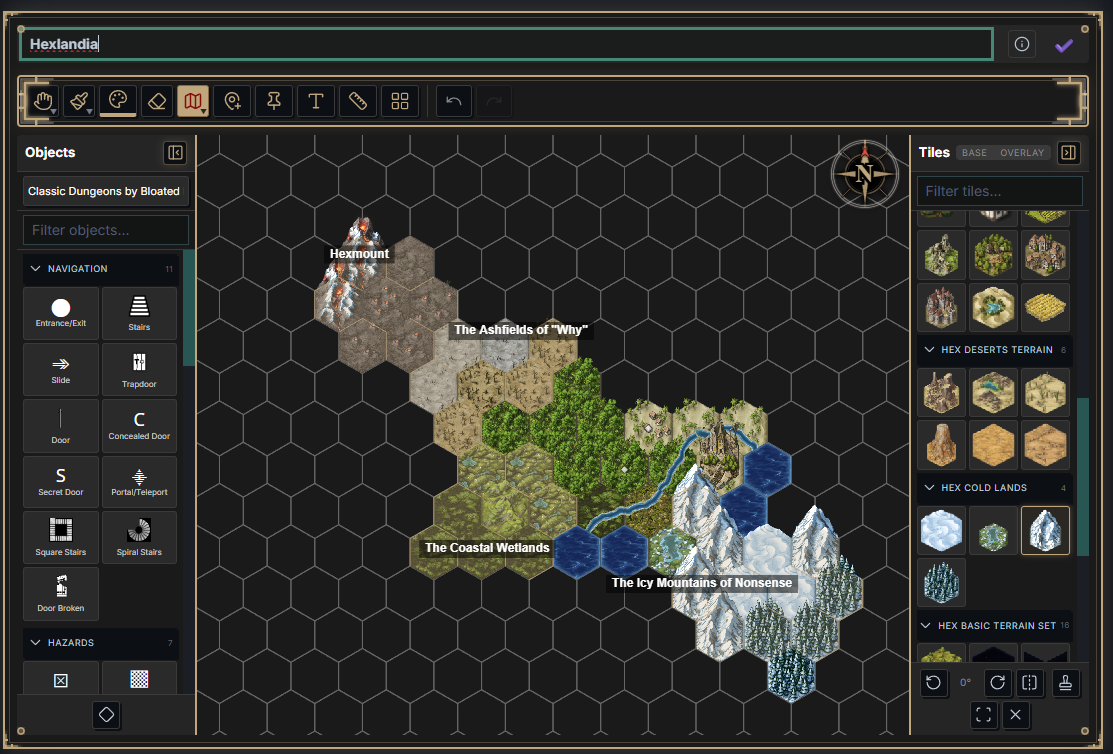
On hex maps you can declare regions with the region tools in the palette — Paint Region (cell by cell) or Draw Boundary (click out a polygon). Regions render at 30% of the selected color’s opacity; you can still paint over them and they coexist. (Requires the Regions feature.)
Name a region in the region toolbar that appears while creating or editing it; the toolbar also shows the region’s hex count. A region’s name floats over it like a fixed label and scales with zoom.
A regions menu in the Map Controls lists every region on the map; from there you can toggle a region’s visibility or jump to it. Edit a region by clicking it with a region tool, or via a right-click / long-press context menu — to change its name, color, assigned hexes, or delete it. Regions can also link to notes.
Sub-maps (HEX ONLY)
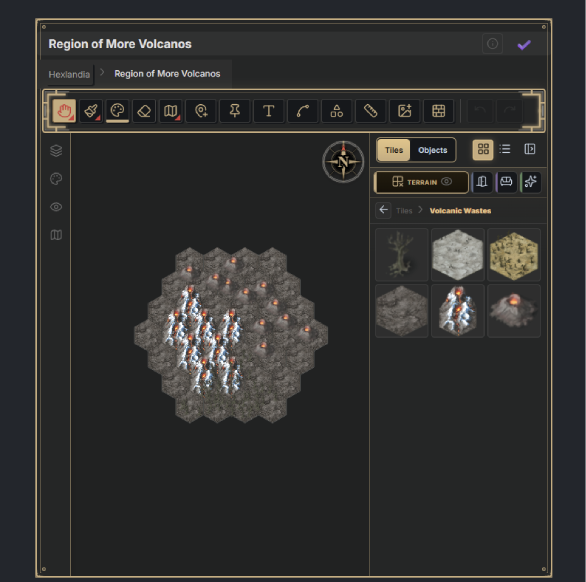
Hex maps can contain sub-maps — nested maps of their own (independent of regions). Create one by double-clicking a hex, or via the right-click / long-press context menu → “Create sub-map.” (Requires the Sub-maps feature.)
Sub-maps default to radial at 7 rings, adjustable per sub-map in Map Settings. Each is effectively a full Windrose instance and supports all tools and functionality, including further sub-maps — there’s no hard nesting limit, though very deep nesting may carry performance or data-size implications.
Inside a sub-map, a breadcrumb UI above the tool palette shows where you are in the hierarchy and lets you jump back up. A hex containing a sub-map shows a diamond icon in its center.
Seamless zoom
Zooming in past a threshold on a hex that holds a sub-map descends into it directly — and the transition is seamless in both directions. The sub-map opens occupying the parent hex’s exact screen footprint with the point under your cursor held fixed, and zooming back out surfaces to the matching parent view. A world map and its sub-maps read as one continuous zoom rather than separate maps opened by hand.
The parent-map backdrop
Inside a sub-map, a static snapshot of the parent map renders behind the sub-grid, aligned to where you dove in — the world doesn’t vanish at the sub-map’s edge. Each nesting level keeps its own backdrop, so surfacing from a deep dive re-exposes the outer level’s view. The backdrop can be toggled off in settings, and a recenter view button (keyboard: Home) snaps the view back to the sub-map’s fit.
Adjacent sub-maps
When neighboring hexes also hold sub-maps with content, Windrose can display them as previews around the current sub-map — and clicking one navigates directly across, sliding the view over smoothly rather than surfacing and diving again.
The adjacent display is off by default: toggle it with the layers button beside the breadcrumb while inside a sub-map. The button appears when at least one neighboring sub-map has content.
Deleting a sub-map
Right-click (or long-press) a hex that has a sub-map and choose Delete Sub-Hex. A confirmation itemizes everything inside — painted cells, shapes, tiles, objects, text labels, and any nested sub-maps — before anything is removed.
Deleting a sub-map removes its whole nested tree and cannot be undone.
Embedding a sub-map
A sub-map can also be embedded on its own, without its parent, using the subhex key on a windrose-map code block (see windrose-map code blocks).